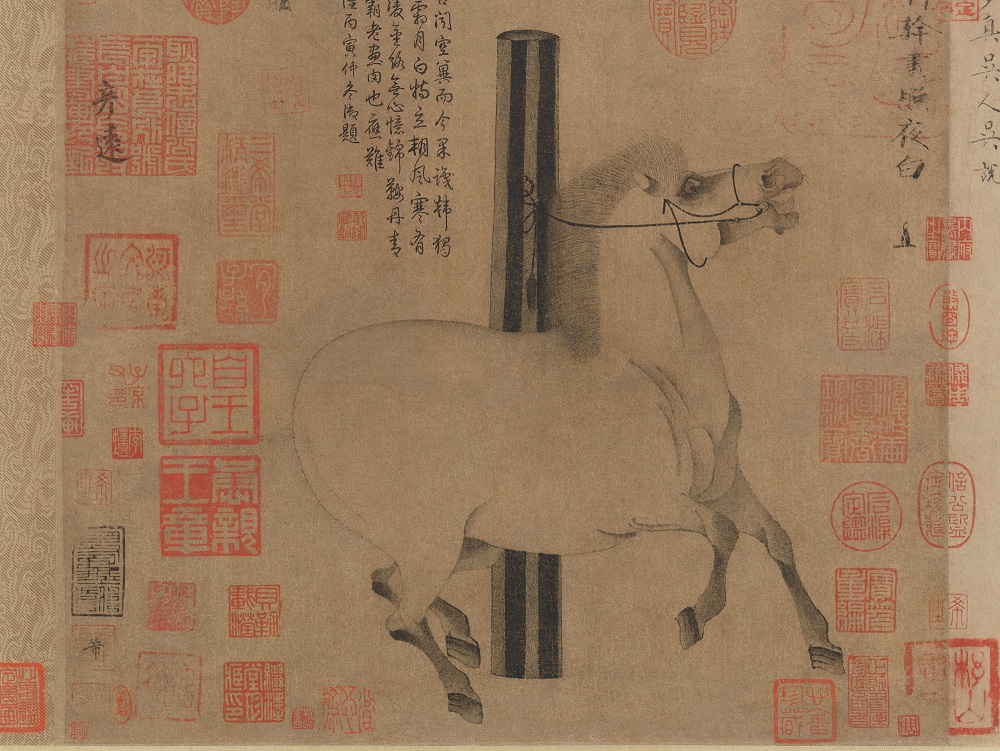
Tethered to a wooden stake, the horse in this painting appears wild-eyed and animated, its head raised with flaring nostrils and an open mouth as if it is emitting a shrill neigh. A leading court painter named Han Gan who specialized in horses is believed to have painted this portrait of “Night-Shining White,” the favored […]
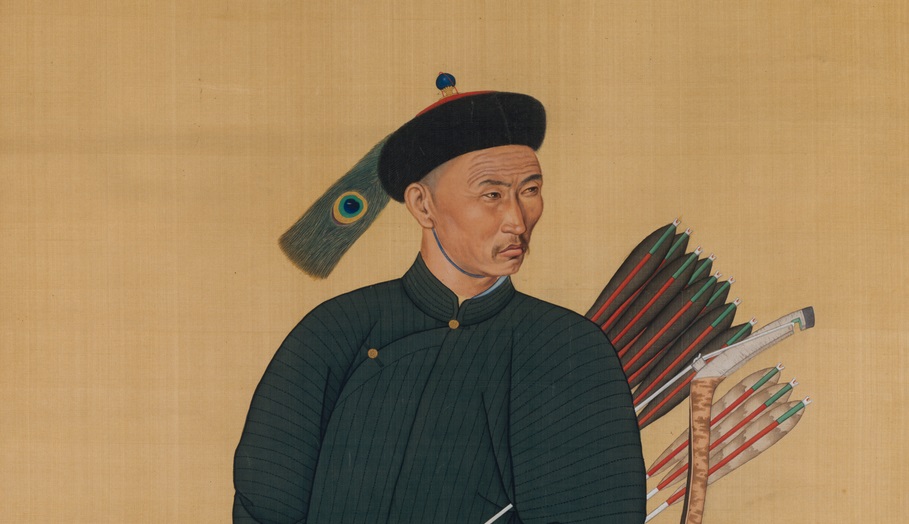
Under the Manchu emperors of the Qing dynasty, portraiture again became an important court-sponsored art. This full-length depiction of an imperial bodyguard of the first rank is from a set of one hundred portraits of loyal officials and valiant warriors commissioned by the Qianlong emperor (r. 1736–95) that originally hung in the Hall of Imperial […]
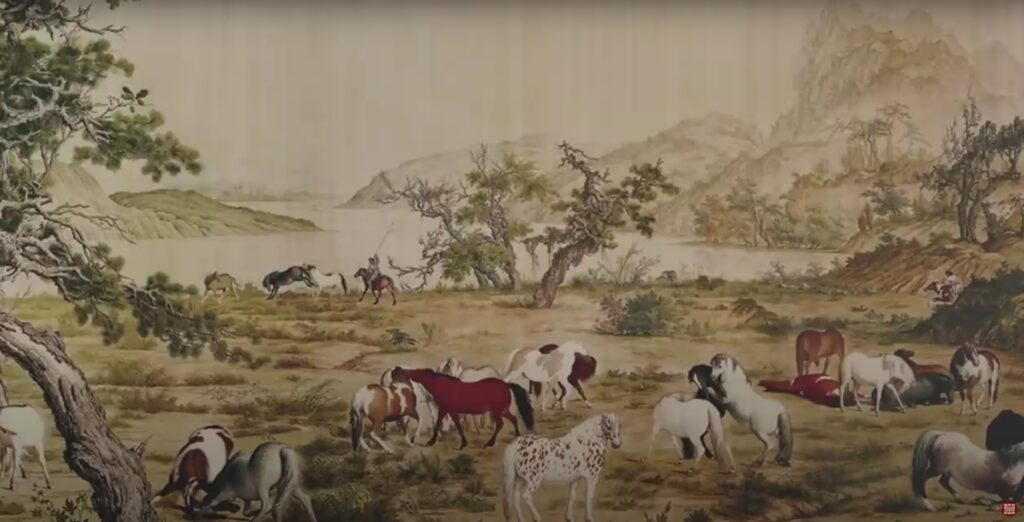
During the eighteenth century, the Manchu Qing dynasty sponsored a major revival of courtly arts, which attained a new monumental scale, technical finish, and descriptive intricacy. A key figure in establishing this new court aesthetic was the Italian Jesuit Giuseppe Castiglione. A master of vividly naturalistic draftsmanship and large-scale compositions, in Europe he worked as […]
By Maxwell Hearn The Chinese way of appreciating a painting is often expressed by the words du hua, “to read a painting.” How does one do that? Consider Night-Shining White by Han Gan (1977.78), an image of a horse. Originally little more than a foot square, it is now mounted as a handscroll that is […]
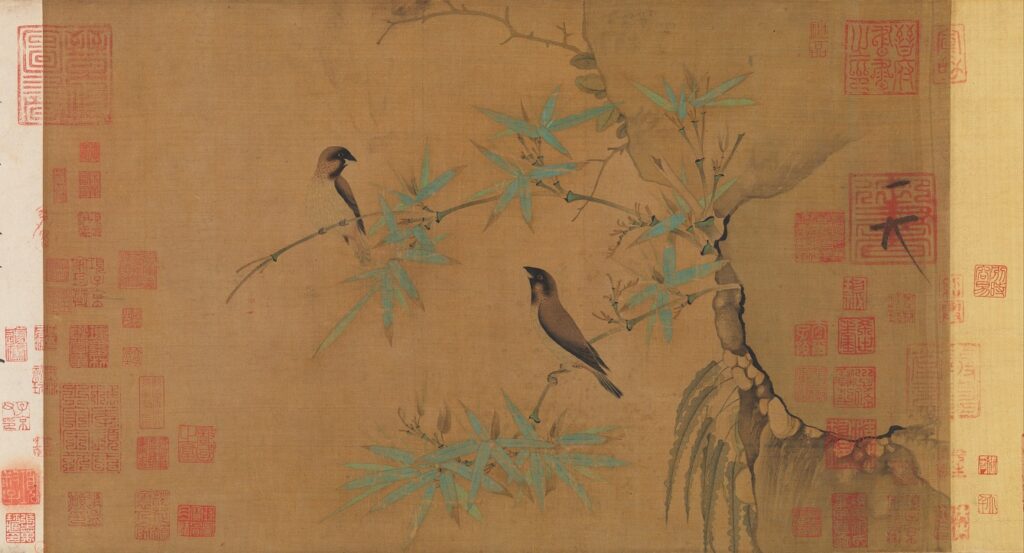
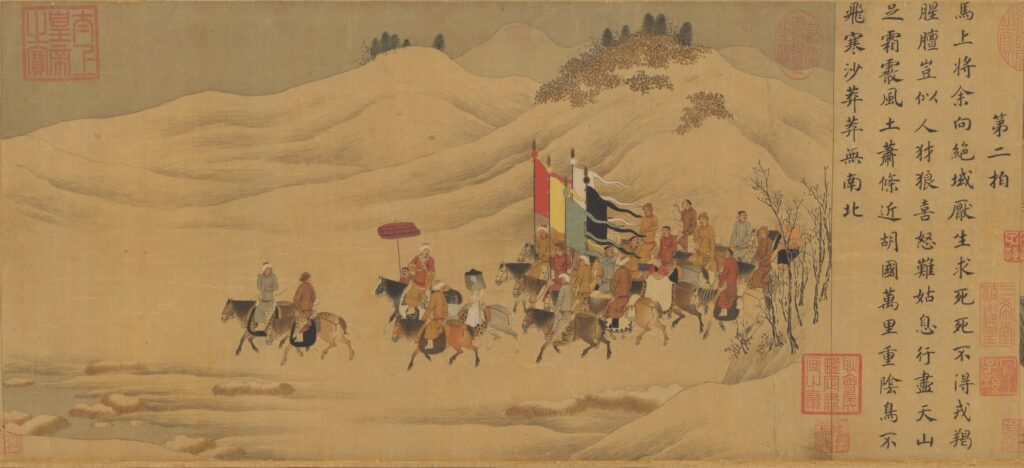
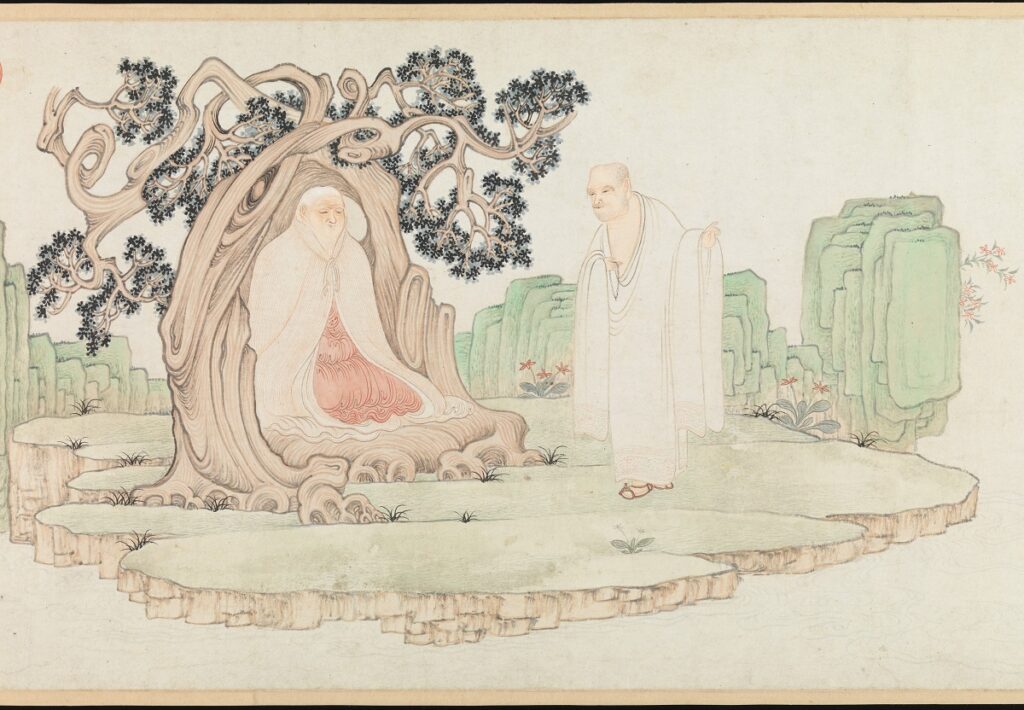
By Shi-yee Liu «The genre of narrative painting in China reached full maturity as early as the fourth century and continues to thrive today. The exhibition Show and Tell: Stories in Chinese Painting—on view at The Met Fifth Avenue through August 6, 2017—explores how Chinese painters have told stories that promote political and cultural agendas […]
By Maxwell Hearn Department of Asian Art, The Metropolitan Museum of Art The Chinese way of appreciating a painting is often expressed by the words du hua, “to read a painting.” How does one do that? Consider Night-Shining White by Han Gan (1977.78), an image of a horse. Originally little more than a foot square, […]
Contact us
Wherever & whenever you are, we are here always.
The Middle Land
100 Wilshire Blvd., Suite 700
Santa Monica, CA 90401
MiddleLand@protonmail.com
Terms and Conditions
October, 2023
Using our website
You may use the The Middle Land website subject to the Terms and Conditions set out on this page. Visit this page regularly to check the latest Terms and Conditions. Access and use of this site constitutes your acceptance of the Terms and Conditions in-force at the time of use.
Intellectual property
Names, images and logos displayed on this site that identify The Middle Land are the intellectual property of New San Cai Inc. Copying any of this material is not permitted without prior written approval from the owner of the relevant intellectual property rights.
Requests for such approval should be directed to the competition committee.
Please provide details of your intended use of the relevant material and include your contact details including name, address, telephone number, fax number and email.
Linking policy
You do not have to ask permission to link directly to pages hosted on this website. However, we do not permit our pages to be loaded directly into frames on your website. Our pages must load into the user’s entire window.
The Middle Land is not responsible for the contents or reliability of any site to which it is hyperlinked and does not necessarily endorse the views expressed within them. Linking to or from this site should not be taken as endorsement of any kind. We cannot guarantee that these links will work all the time and have no control over the availability of the linked pages.
Submissions
All information, data, text, graphics or any other materials whatsoever uploaded or transmitted by you is your sole responsibility. This means that you are entirely responsible for all content you upload, post, email or otherwise transmit to the The Middle Land website.
Virus protection
We make every effort to check and test material at all stages of production. It is always recommended to run an anti-virus program on all material downloaded from the Internet. We cannot accept any responsibility for any loss, disruption or damage to your data or computer system, which may occur while using material derived from this website.
Disclaimer
The website is provided ‘as is’, without any representation or endorsement made, and without warranty of any kind whether express or implied.
Your use of any information or materials on this website is entirely at your own risk, for which we shall not be liable. It is your responsibility to ensure any products, services or information available through this website meet your specific requirements.
We do not warrant the operation of this site will be uninterrupted or error free, that defects will be corrected, or that this site or the server that makes it available are free of viruses or represent the full functionality, accuracy and reliability of the materials. In no event will we be liable for any loss or damage including, without limitation, loss of profits, indirect or consequential loss or damage, or any loss or damages whatsoever arising from the use, or loss of data, arising out of – or in connection with – the use of this website.
Privacy & Cookie Policy
September 11, 2024
Last Updated: September 11, 2024
New San Cai Inc. (hereinafter “The Middle Land,” “we,” “us,” or “our”) owns and operates www.themiddleland.com, its affiliated websites and applications (our “Sites”), and provides related products, services, newsletters, and other offerings (together with the Sites, our “Services”) to art lovers and visitors around the world.
This Privacy Policy (the “Policy”) is intended to provide you with information on how we collect, use, and share your personal data. We process personal data from visitors of our Sites, users of our Services, readers or bloggers (collectively, “you” or “your”). Personal data is any information about you. This Policy also describes your choices regarding use, access, and correction of your personal information.
If after reading this Policy you have additional questions or would like further information, please email at middleland@protonmail.com.
PERSONAL DATA WE COLLECT AND HOW WE USE IT
We collect and process personal data only for lawful reasons, such as our legitimate business interests, your consent, or to fulfill our legal or contractual obligations.
Information You Provide to Us
Most of the information Join Talents collects is provided by you voluntarily while using our Services. We do not request highly sensitive data, such as health or medical information, racial or ethnic origin, political opinions, religious or philosophical beliefs, trade union membership, etc. and we ask that you refrain from sending us any such information.
Here are the types of personal data that you voluntarily provide to us:
Name, email address, and any other contact information that you provide by filling out your profile forms
Billing information, such as credit card number and billing address
Work or professional information, such as your company or job title
Unique identifiers, such as username or password
Demographic information, such as age, education, interests, and ZIP code
Details of transactions and preferences from your use of the Services
Correspondence with other users or business that you send through our Services, as well as correspondence sent to JoinTalents.com
As a registered users or customers, you may ask us to review or retrieve emails sent to your business. We will access these emails to provide these services for you.
We use the personal data you provide to us for the following business purposes:
Set up and administer your account
Provide and improve the Services, including displaying content based on your previous transactions and preferences
Answer your inquiries and provide customer service
Send you marketing communications about our Services, including our newsletters (please see the Your Rights/Opt Out section below for how to opt out of marketing communications)
Communicate with users who registered their accounts on our site
Prevent, discover, and investigate fraud, criminal activity, or violations of our Terms and Conditions
Administer contests and events you entered
Information Obtained from Third-Party Sources
We collect and publish biographical and other information about users, which we use to promote the articles and our bloggerswho use our sites. If you provide personal information about others, or if others give us your information, we will only use that information for the specific reason for which it was provided.
Information We Collect by Automated Means
Log Files
The site uses your IP address to help diagnose server problems, and to administer our website. We use your IP addresses to analyze trends and gather broad demographic information for aggregate use.
Every time you access our Site, some data is temporarily stored and processed in a log file, such as your IP addresses, the browser types, the operating systems, the recalled page, or the date and time of the recall. This data is only evaluated for statistical purposes, such as to help us diagnose problems with our servers, to administer our sites, or to improve our Services.
Do Not Track
Your browser or device may include “Do Not Track” functionality. Our information collection and disclosure practices, and the choices that we provide to customers, will continue to operate as described in this Privacy Policy, whether or not a “Do Not Track” signal is received.
HOW WE SHARE YOUR INFORMATION
We may share your personal data with third parties only in the ways that are described in this Privacy Policy. We do not sell, rent, or lease your personal data to third parties, and We does not transfer your personal data to third parties for their direct marketing purposes.
We may share your personal data with third parties as follows:
With service providers under contract to help provide the Services and assist us with our business operations (such as our direct marketing, payment processing, fraud investigations, bill collection, affiliate and rewards programs)
As required by law, such as to comply with a subpoena, or similar legal process, including to meet national security or law enforcement requirements
When we believe in good faith that disclosure is necessary to protect rights or safety, investigate fraud, or respond to a government request
With other users of the Services that you interact with to help you complete a transaction
There may be other instances where we share your personal data with third parties based on your consent.
HOW WE STORE AND SECURE YOUR INFORMATION
We retain your information for as long as your account is active or as needed to provide you Services. If you wish to cancel your account, please contact us middleland@protonmail.com. We will retain and use your personal data as necessary to comply with legal obligations, resolve disputes, and enforce our agreements.
All you and our data are stored in the server in the United States, we do not sales or transfer your personal data to the third party. All information you provide is stored on a secure server, and we generally accepted industry standards to protect the personal data we process both during transmission and once received.
YOUR RIGHTS/OPT OUT
You may correct, update, amend, delete/remove, or deactivate your account and personal data by making the change on your Blog on www.themiddleland.com or by emailing middleland@protonmail.com. We will respond to your request within a reasonable timeframe.
You may choose to stop receiving Join Talents newsletters or marketing emails at any time by following the unsubscribe instructions included in those communications, or you can email us at middleland@protonmail.com
LINKS TO OTHER WEBSITES
The Middle Land include links to other websites whose privacy practices may differ from that of ours. If you submit personal data to any of those sites, your information is governed by their privacy statements. We encourage you to carefully read the Privacy Policy of any website you visit.
NOTE TO PARENTS OR GUARDIANS
Our Services are not intended for use by children, and we do not knowingly or intentionally solicit data from or market to children under the age of 18. We reserve the right to delete the child’s information and the child’s registration on the Sites.
PRIVACY POLICY CHANGES
We may update this Privacy Policy to reflect changes to our personal data processing practices. If any material changes are made, we will notify you on the Sites prior to the change becoming effective. You are encouraged to periodically review this Policy.
HOW TO CONTACT US
If you have any questions about our Privacy Policy, please email middleland@protonmail.com
TestI am a description. Click the edit button to change this text.
New Programs Added to Your Plan
March 2, 2023
The Michelin brothers created the guide, which included information like maps, car mechanics listings, hotels and petrol stations across France to spur demand.
The guide began to award stars to fine dining restaurants in 1926.
At first, they offered just one star, the concept was expanded in 1931 to include one, two and three stars. One star establishments represent a “very good restaurant in its category”. Two honour “excellent cooking, worth a detour” and three reward “exceptional cuisine, worth a